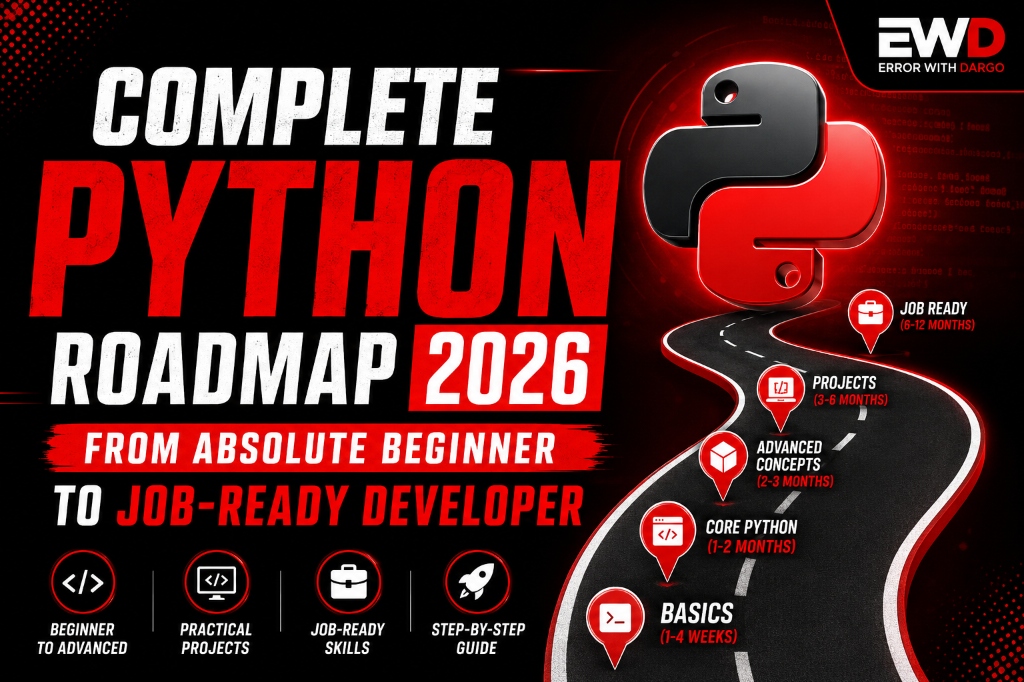
Complete Python Roadmap 2026: From Absolute Beginner to Job-Ready Developer
Python is one of the most popular programming languages in the world. Whether you want to become a software developer, data scientist, AI engineer, automation expert, or freelancer, Python is often the best place to start. Its simple syntax, huge community, and vast ecosystem of libraries make it beginner-friendly while remaining powerful enough for professional applications.
In this guide, you'll learn a complete roadmap to go from absolute beginner to job-ready Python developer in 2026.
Why Learn Python in 2026?
Python continues to dominate multiple industries because of its versatility.
Python is used in:
- Artificial Intelligence (AI)
- Machine Learning
- Data Science
- Web Development
- Automation
- Cybersecurity
- Game Development
- Cloud Computing
- Financial Analysis
Major companies like Google, Netflix, Spotify, and Instagram use Python extensively.
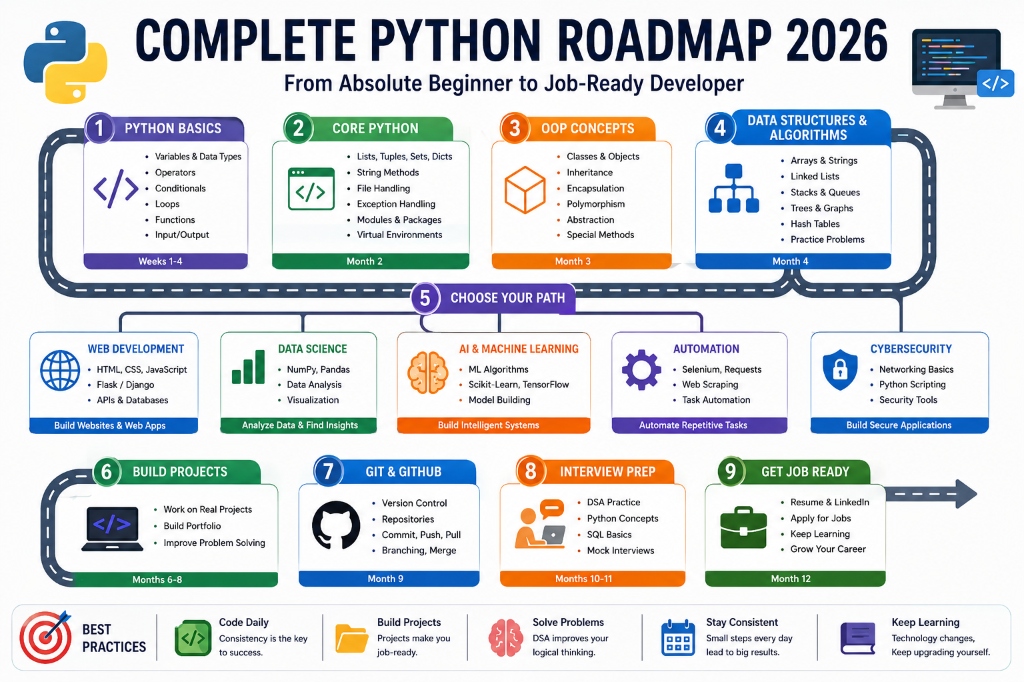
Stage 1: Learn Python Fundamentals (Weeks 1–4)
Before building projects, you must understand the core concepts.
Topics to Learn
Variables and Data Types
name = "John"
age = 18
height = 5.8
Input and Output
name = input("Enter your name: ")
print("Hello", name)
Operators
- Arithmetic Operators
- Comparison Operators
- Logical Operators
Conditional Statements
if age >= 18:
    print("Adult")
else:
    print("Minor")
Loops
for i in range(5):
    print(i)
Functions
def greet():
    print("Hello World")
Beginner Projects
- Calculator
- Number Guessing Game
- BMI Calculator
- To-Do List
- Password Generator
Stage 2: Master Core Python (Month 2)
Once you understand the basics, move toward intermediate concepts.
Topics
Lists
fruits = ["apple", "banana", "orange"]Tuples
Dictionaries
student = {
    "name": "Alex",
    "age": 18
}
Sets
Exception Handling
try:
    x = 10/0
except:
    print("Error")
File Handling
file = open("data.txt", "r")
print(file.read())
Modules and Packages
Virtual Environments
Projects
- Expense Tracker
- Contact Book
- Quiz Application
- Student Management System
Stage 3: Learn Object-Oriented Programming (Month 3)
OOP is essential for professional development.
Concepts
- Classes & Objects
- Inheritance
- Encapsulation
- Polymorphism
- Abstraction
class Student:
    def __init__(self, name, age):
        self.name = name
        self.age = age

# Creating an Object
s1 = Student("Alex", 18)
Project
Build a Library Management System using OOP principles.
Stage 4: Data Structures and Algorithms (Month 4)
Many companies ask DSA questions in interviews.
Learn
- Arrays & Strings
- Linked Lists
- Stacks & Queues
- Trees & Graphs
- Hash Tables
Practice Platforms
- LeetCode
- HackerRank
- Codeforces
Goal: Solve at least 100 coding problems.
Stage 5: Choose Your Career Path (Months 5–8)
After learning Python fundamentals, select a specialization.
Path 1: Web Development
Learn how to design backends and full stack web solutions.
- Learn: HTML, CSS, JavaScript, Flask, Django, APIs, Databases
- Projects: Blog Website, Portfolio Website, E-Commerce Store
Path 2: Data Science
Learn how to extract insights from structured/unstructured datasets.
- Learn: NumPy, Pandas, Matplotlib, Seaborn, Jupyter Notebook
- Projects: Sales Analysis, Student Performance Analysis, Data Visualization Dashboard
Path 3: Artificial Intelligence & Machine Learning
Teach models how to predict outputs from training data.
- Learn: Linear Algebra, Statistics, Machine Learning, Deep Learning
- Libraries: Scikit-Learn, TensorFlow, PyTorch
- Projects: House Price Predictor, Spam Email Detector, Image Classifier
Path 4: Automation
Automate recurring tasks and write custom script automation routines.
- Learn: Selenium, Requests, BeautifulSoup
- Projects: Auto Email Sender, Web Scraper, Social Media Automation Tool
Path 5: Cybersecurity
Learn security operations and write penetration testing tools.
- Learn: Networking Basics, Linux, Ethical Hacking Concepts, Python Scripting
- Projects: Port Scanner, Log Analyzer, Password Strength Checker
Stage 6: Build a Strong Portfolio (Months 8–10)
A portfolio is often more important than certificates.
Include
- GitHub Profile
- Personal Website
- Resume
- 5–10 Quality Projects
Best Projects
- Beginner: Calculator, To-Do App
- Intermediate: Expense Tracker, Chat Application
- Advanced: AI Chatbot, E-Commerce Website, Face Recognition System
Stage 7: Learn Git and GitHub
Every developer should know version control.
Learn
- Repository
- Commit, Push, and Pull
- Branching & Merge
Basic Commands:
git init
git add .
git commit -m "first commit"
git push
Stage 8: Prepare for Jobs (Months 10–12)
Technical Interview Preparation
Focus on Python Fundamentals, OOP, DSA, SQL, and Projects.
Common Interview Questions
- Difference between List and Tuple?
- What is Inheritance?
- Explain Python Decorators.
- What are Generators?
- Difference between Deep Copy and Shallow Copy?
Python Developer Salary in 2026
Approximate salary ranges vary by country, company, and skill level.
- Entry Level: Internship (₹10,000–₹50,000/month) | Junior Developer (₹4–8 LPA)
- Mid Level: ₹10–20 LPA
- Advanced Roles: ₹20 LPA+
Specialized fields like AI, Machine Learning, and Quantitative Finance may offer significantly higher compensation.
Common Mistakes Beginners Make
- ❌ Watching tutorials without coding
- ❌ Copy-pasting code
- ❌ Ignoring projects
- ❌ Learning too many languages at once
- ❌ Avoiding DSA
- ❌ Not building a GitHub profile
12-Month Python Learning Plan
| Month | Focus |
|---|---|
| 1 | Python Basics |
| 2 | Intermediate Python |
| 3 | OOP |
| 4 | DSA |
| 5 | Web Development / Data Science |
| 6 | Advanced Concepts |
| 7 | Projects |
| 8 | Portfolio |
| 9 | Git & GitHub |
| 10 | Advanced Projects |
| 11 | Interview Preparation |
| 12 | Apply for Jobs |
Final Thoughts
Python remains one of the best programming languages to learn in 2026. The key is not just learning syntax but consistently building projects, solving problems, and creating a portfolio that demonstrates your skills.
If you follow this roadmap, practice regularly, and build real-world projects, you can progress from an absolute beginner to a job-ready Python developer within a year. Success in programming comes from consistency, curiosity, and continuous learning—not from watching endless tutorials.
Start today, build projects, and let your code speak for itself. 🚀