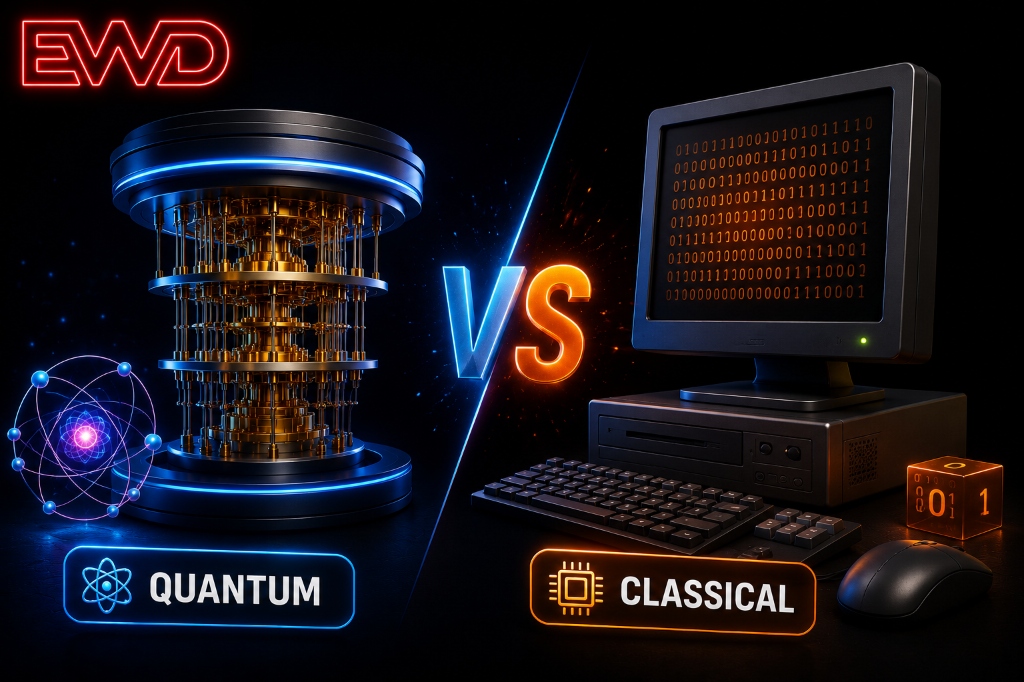
Quantum Computer vs Classical Computer: The Ultimate Comparison (2026)
Technology has evolved rapidly over the past few decades. From room-sized computers to powerful smartphones, computing power has increased dramatically. However, scientists and engineers are now working on a revolutionary technology that could change the future of computing forever: Quantum Computing.
While classical computers power everything from websites and mobile apps to supercomputers, quantum computers promise to solve problems that would take classical computers thousands or even millions of years to complete.
But what exactly is the difference between a Quantum Computer and a Classical Computer?
In this ultimate comparison guide, we'll explore how both technologies work, their strengths, limitations, and what the future might look like.
What Is a Classical Computer?
A classical computer is the type of computer we use every day.
Examples include:
- Desktop Computers
- Laptops
- Smartphones
- Gaming Consoles
- Servers
- Supercomputers
Classical computers process information using bits.
A bit can only have one of two values:
Everything you do on your device—from watching YouTube videos to playing games—is ultimately represented by billions of these binary bits.
What Is a Quantum Computer?
A quantum computer is a new type of computer that uses the principles of quantum mechanics to process information.
Instead of bits, quantum computers use qubits (quantum bits).
Unlike classical bits, qubits can exist in multiple states simultaneously.
This property gives quantum computers enormous computational potential.
Bits vs Qubits
The biggest difference between classical and quantum computing lies in how information is stored.
Classical Bit
A classical bit can only be:
Never both at the same time.
Quantum Bit (Qubit)
A qubit can be:
This phenomenon is called Superposition.
Because of superposition, quantum computers can process many possibilities simultaneously.
How Classical Computers Work
Classical computers rely on:
- Transistors
- Logic Gates
- Binary Operations
- CPUs and GPUs
When you run a program, the computer performs calculations step-by-step using electrical signals. This approach is incredibly efficient for everyday computing tasks.
How Quantum Computers Work
Quantum computers use principles from quantum physics such as:
Superposition
A qubit can represent multiple states simultaneously.
Entanglement
Two qubits can become connected in a way that the state of one instantly affects the other.
Quantum Interference
Quantum states can be manipulated to increase the probability of correct answers.
These phenomena allow quantum computers to solve specific problems much faster than traditional computers.
Classical Computer Architecture
A traditional computer contains:
- CPU
- RAM
- Storage
- Motherboard
- GPU
- Power Supply
These components process and store information using binary logic.
Quantum Computer Architecture
Quantum computers use highly specialized hardware:
- Qubits
- Quantum Processors
- Cryogenic Cooling Systems
- Microwave Control Electronics
- Quantum Error Correction Systems
Many quantum computers operate near absolute zero temperature:
This helps maintain stable quantum states.
Speed Comparison
Classical Computers
Modern supercomputers are extremely powerful. They can perform:
- Trillions of calculations per second
- Large-scale simulations
- Complex scientific computations
Quantum Computers
For certain specialized problems, quantum computers can outperform classical systems dramatically. Problems involving:
- Cryptography
- Optimization
- Molecular Simulation
- Quantum Physics
may be solved exponentially faster. However, quantum computers are not universally faster for every task.
Storage & Processing Comparison
| Feature | Classical Computer | Quantum Computer |
|---|---|---|
| Unit | Bit | Qubit |
| States | 0 or 1 | 0, 1, or both simultaneously |
| Data Representation | Binary | Quantum States |
| Processing Style | Sequential / Parallel Threads | Parallel Possibilities (Superposition) |
Real-World Applications
Classical Computers
Used for:
- Web Browsing
- Gaming
- Mobile Apps
- Software Development
- Databases
- Video Editing
Quantum Computers
Potential applications include:
- Drug Discovery
- Climate Modeling
- Financial Optimization
- Artificial Intelligence
- Material Science
- Cryptography
Artificial Intelligence and Machine Learning
AI currently runs on classical computers. However, researchers believe Quantum AI could revolutionize:
- Training Speed
- Optimization
- Pattern Recognition
- Data Analysis
Quantum Machine Learning is one of the most exciting research areas today.
Cybersecurity Impact
One of the biggest concerns surrounding quantum computing is cybersecurity.
Most current encryption methods rely on mathematical problems that are difficult for classical computers to solve. Powerful quantum computers could potentially break some modern encryption systems. As a result, researchers are developing:
Post-Quantum Cryptography
New encryption techniques designed to resist quantum attacks.
Advantages Comparison
Advantages of Classical Computers
- Mature Technology: Used worldwide for decades.
- Affordable: Available to everyone.
- Reliable: Highly stable and practical.
- Excellent for Everyday Tasks: Perfect for gaming, browsing, and productivity.
Advantages of Quantum Computers
- Massive Parallelism: Can evaluate multiple possibilities simultaneously.
- Solving Complex Problems: Particularly useful for scientific research.
- Revolutionary Potential: Could transform medicine, AI, finance, and cybersecurity.
Limitations Comparison
Limitations of Classical Computers
- Scaling Challenges: Some problems become computationally impossible.
- Energy Consumption: Large data centers consume enormous amounts of electricity.
- Processing Bottlenecks: Certain calculations remain extremely difficult.
Limitations of Quantum Computers
- Extremely Expensive: Quantum hardware costs millions of dollars.
- Error-Prone: Qubits are fragile and difficult to maintain.
- Limited Availability: Only a few organizations currently operate advanced quantum systems.
- Specialized Usage: Not useful for most everyday tasks.
Leading Companies in Quantum Computing
Several organizations are investing heavily in quantum technology:
- IBM
- Microsoft
- Intel
- Amazon
- Rigetti
- D-Wave
These companies are racing to build more powerful and stable quantum computers.
Will Quantum Computers Replace Classical Computers?
The answer is: No—not completely.
Quantum computers are not expected to replace laptops, smartphones, or traditional computers. Instead, they will work alongside classical computers. Future systems may combine:
- Classical Computing
- Artificial Intelligence
- Quantum Processing
to solve previously impossible problems.
The Future of Quantum Computing
Experts believe quantum computing could become one of the most transformative technologies of the 21st century. Possible future breakthroughs include:
- Faster drug discovery
- Advanced AI systems
- Better climate simulations
- Stronger cybersecurity solutions
- Revolutionary scientific discoveries
Although widespread adoption may still take years, progress is accelerating rapidly.
Final Verdict
Classical computers remain the foundation of modern technology and are perfect for everyday computing tasks. Quantum computers, on the other hand, represent the next frontier of innovation, offering unprecedented computational power for specific types of problems.
The future isn't Quantum vs Classical.
"The future is Quantum + Classical Computing Working Together."
As quantum technology matures, we may witness breakthroughs that transform industries, redefine scientific research, and unlock possibilities that were once considered impossible. The quantum revolution has only just begun.
FAQs
Can I buy a quantum computer?
Not currently. Most quantum computers are accessible through cloud platforms provided by major technology companies.
Are quantum computers faster than supercomputers?
For specific problems, yes. For everyday tasks, no.
Will quantum computers replace programmers?
No. They will create new opportunities and tools for developers.
Should students learn quantum computing?
Absolutely. Quantum computing is expected to be one of the most important emerging technologies of the coming decades.